

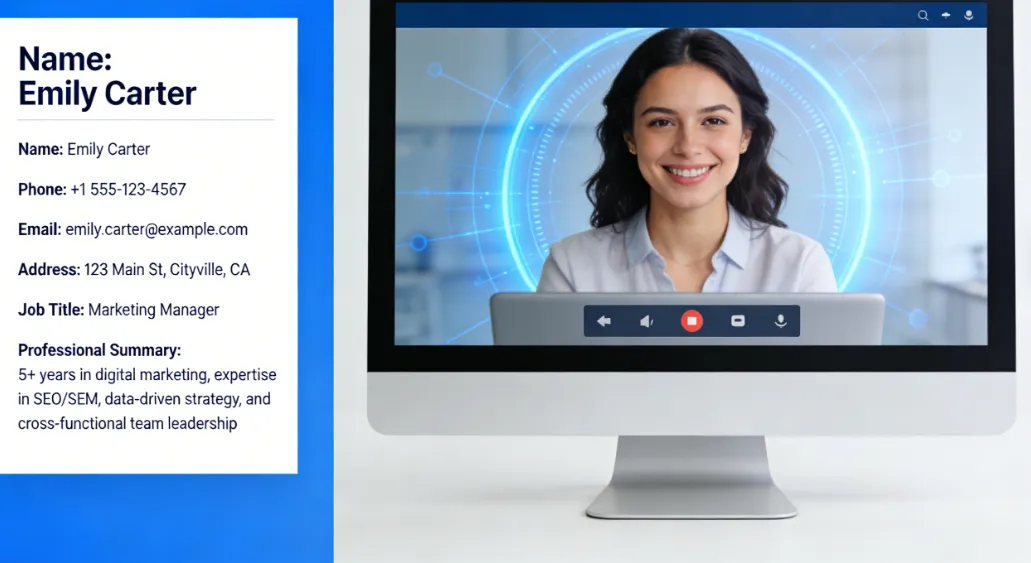
If you’ve spent weeks (or months) sending out resumes and only getting crickets in return, you’re not alone. The average job seeker in the U.S. and Europe submits 10–15 applications per week, yet only 2–3% of those lead to interviews. I’ve been there too—staring at a screen, wondering why my “perfect” resume wasn’t getting a second look, why I was being passed over for roles I was more than qualified for. It wasn’t until I cracked the code of ATS optimization, aligned my resume with interview success, and stopped treating these two steps as separate that I went from zero interviews to multiple job offers in 6 weeks. This is the story of the resume that got me interviews, the ATS tips that made it happen, and how bridging the gap between your resume and interview performance is the key to landing the job you deserve.
Let’s get real: The job market in 2026 is brutal. With the global ATS market projected to nearly double from $17.22 billion in 2025 to $30.51 billion by 2031, AI-driven applicant tracking systems are no longer a “nice-to-have” for employers—they’re a necessity. Three in 10 UK employers now use AI in their recruitment processes, and in the U.S., over 75% of companies rely on ATS to screen resumes before a human ever sees them. That means your resume isn’t just competing against other candidates—it’s competing against a bot first. And if your resume isn’t optimized for ATS, it will be tossed aside before a recruiter even glances at your experience. But here’s the good news: ATS optimization isn’t rocket science. It’s a set of simple, actionable steps that anyone can follow to get their resume in front of human eyes. And once you do that, the real work begins—turning that interview invitation into a job offer by aligning your resume’s story with your interview performance.
The Resume That Got Me Interviews: It’s Not About Perfection—It’s About Alignment
Before I optimized my resume for ATS and aligned it with interview success, I was making the same mistakes most job seekers make: I had a “one-size-fits-all” resume that listed my duties, not my achievements. I used fancy fonts and graphics to make it “stand out,” and I ignored the job description when crafting my experience. Sound familiar? I’d apply for marketing roles with a resume that highlighted my customer service experience, or for project management roles without mentioning key tools like Asana or Trello. Unsurprisingly, I got zero interviews—even though I had the skills and experience to do the job.
Then, I decided to rewrite my resume from scratch, focusing on two things: ATS compatibility and interview readiness. The result? A resume that got me 8 interviews in 4 weeks—including interviews with companies I’d dreamed of working for. This wasn’t a “perfect” resume by traditional standards. It didn’t have flashy designs or overly complex language. It was simple, clear, and tailored to the roles I was applying for. Most importantly, it was built to pass ATS screenings and give me the confidence I needed to ace the interviews that followed.
The biggest lesson I learned? Your resume isn’t just a document—it’s a marketing tool. Its sole purpose is to get you an interview. And to do that, it needs to speak two languages: the language of ATS bots and the language of human recruiters. When you master both, you’ll go from being invisible to being impossible to ignore. Let’s break down exactly how I built the resume that got me interviews, starting with the ATS tips that made all the difference.
ATS Resume Tips 2026: Beat the Bots and Get Your Resume Seen
If you’ve ever applied for a job online and never heard back, chances are your resume didn’t pass the ATS screening. ATS (Applicant Tracking System) is software that employers use to scan, sort, and rank resumes based on how well they match the job description. Modern ATS systems use natural language processing (NLP) to understand context, not just count keywords—which means old tricks like keyword stuffing won’t work. Instead, you need to optimize your resume in a way that’s both bot-friendly and human-readable. Here are the ATS resume tips that got my resume past the bots and into the hands of recruiters:
1. Speak the Exact Language of the Job Description (Semantic Keywords Matter)
ATS systems are designed to match your resume to the job description. That means if the job posting says “customer engagement,” you shouldn’t write “client interaction”—even if they mean the same thing. Modern ATS doesn’t just look for words; it looks for “entities” (related terms and concepts). For example, if you’re applying for a hotel restaurant manager role, the AI expects to see related terms like P&L management, hospitality compliance, and guest retention metrics. I used to make the mistake of using my own terminology, but once I started copying exact phrases from the job description (without lying, of course), my resume started getting noticed.
Pro Tip: Use our website’s free ATS Keyword Scanner to paste the job description and your resume—we’ll highlight the missing keywords and semantic terms that are holding you back. It’s the same tool I used to optimize my resume, and it cut my application time in half while doubling my interview rate.
2. Ditch the Fancy Formatting (Keep It Parsing-Safe)
ATS bots struggle to read complex formatting. Graphics, text boxes, columns, unique fonts, and even some bullet points can cause the system to misparse your resume—meaning your key skills and experience get lost. When I optimized my resume, I switched to a clean, single-column format with a simple font (Arial or Times New Roman, 10–12pt), standard bullet points, and plenty of white space. I removed all graphics, logos, and colored text, and saved my resume as a PDF (to ensure formatting stays consistent across devices). This simple change ensured the ATS could read every word of my resume—and that recruiters could too.
Warning: Avoid using Google Docs’ “columns” feature or text boxes—ATS often skips these entirely. Stick to a linear, easy-to-read layout, and your resume will thank you.
3. Quantify Everything (Use the X-Y-Z Achievement Formula)
ATS systems prioritize measurable achievements over generic duties. Instead of writing “Managed a team,” write “Led a 15-person sales team to deliver $3.2M in new business, exceeding targets by 28%.” This not only catches the ATS’s attention (it loves numbers and action verbs) but also gives recruiters a clear picture of your impact. I used the 2026 X-Y-Z formula for every bullet point: “Accomplished (X) as measured by (Y), by doing (Z).” For example: “Increased e-commerce revenue by 47% (X) through data-driven campaigns and strategic partnerships (Z), resulting in a 22% boost in customer retention (Y).”
Pro Tip: If you’re struggling to quantify your achievements, use our website’s Achievement Builder tool. It asks you simple questions about your role and experience, then generates quantifiable bullet points that ATS loves—saving you hours of frustration.
4. Spell Out Abbreviations (And Avoid Jargon Overload)
ATS bots often miss abbreviations unless they’re spelled out first. For example, if you’re a “SEO Specialist,” write “Search Engine Optimization (SEO) Specialist” the first time you mention it. This ensures the ATS recognizes the term, even if the job description uses the abbreviation. Similarly, avoid industry jargon that’s too niche—if the job description doesn’t use it, the ATS won’t either. I used to fill my resume with terms like “omnichannel marketing synergy,” but once I simplified my language to match the job description, my resume started ranking higher in ATS searches.
5. Tailor Your Resume for Every Role (No More One-Size-Fits-All)
This is the most important ATS tip—and the one most job seekers skip. Every job you apply for is different, even if the titles are similar. A marketing role at a startup requires different skills than a marketing role at a Fortune 500 company. I used to send the same resume to every job, but once I started tailoring my resume for each role—adjusting keywords, highlighting relevant experience, and aligning my achievements with the job’s priorities—my interview rate skyrocketed. It takes a little extra time, but it’s worth it: Tailored resumes are 3x more likely to pass ATS screenings and get interviews.
Pro Tip: Use our website’s Resume Tailoring Tool to upload the job description and your resume—we’ll automatically adjust your resume to match the role’s keywords and priorities, so you can apply faster and get more interviews. It’s the same tool that helped me go from 0 to 8 interviews in 4 weeks.
Resume vs. Interview Success: They’re Not Separate—They’re Two Sides of the Same Coin
Here’s a common mistake job seekers make: They treat their resume and interview as two separate steps. They spend hours optimizing their resume to get an interview, then show up to the interview unprepared to talk about the experience on their resume. I did this too—once, I got an interview for a marketing role, but I couldn’t explain the metrics on my resume when the recruiter asked. I froze, and I didn’t get the job. That’s when I realized: Your resume is the foundation of your interview success. The two are inseparable.
Think about it: Your resume is a static document that tells your professional story. Your interview is the dynamic version of that story—where you get to bring your achievements to life, show your personality, and prove you’re the right fit for the role. If your resume says you “increased sales by 50%,” but you can’t explain how you did it in the interview, the recruiter will think you’re lying. If your resume highlights your leadership skills, but you’re nervous and hesitant in the interview, the recruiter won’t believe you’re a leader. The key to success is aligning your resume and your interview—so that every bullet point on your resume is a story you can tell confidently in the interview.
How to Align Your Resume with Interview Success
The resume that got me interviews wasn’t just ATS-optimized—it was interview-ready. Here’s how I ensured my resume and interview worked together to land me offers:
1. Use Your Resume as a Interview Cheat Sheet (But Don’t Memorize It)
When I was preparing for interviews, I used my resume as a guide. I went through every bullet point and asked myself: “Can I explain this achievement in detail? Can I talk about the challenges I faced, the actions I took, and the results I got?” This is where the STAR (Situation, Task, Action, Result) or CAR (Challenge, Action, Result) method comes in. For every achievement on your resume, prepare a 60–90 second story using STAR/CAR. For example, if your resume says “Cut delivery time by 35%,” your STAR story might be: “Situation: Our team was struggling to meet client deadlines, leading to 15% of clients churning. Task: I was tasked with streamlining our delivery process. Action: I analyzed our workflow, identified bottlenecks, and implemented a new project management tool. Result: We cut delivery time by 35%, reduced client churn by 10%, and increased client satisfaction scores by 20%.”
Pro Tip: Use our website’s Interview Prep Tool to generate STAR stories for every bullet point on your resume. It’s a game-changer—no more struggling to come up with stories on the spot. I used it before every interview, and it gave me the confidence to speak clearly and convincingly about my experience.
2. Highlight Cultural Fit (Resumes Don’t Show Personality—Interviews Do)
Your resume can show your skills and experience, but it can’t show your personality, your values, or how well you’ll fit into a company’s culture. Recruiters don’t just hire for skills—they hire for fit. In fact, 89% of hiring managers say cultural fit is just as important as technical skills. When I optimized my resume, I added subtle hints about my work style (e.g., “Collaborated with cross-functional teams to launch a new product”) to signal that I’m a team player. Then, in the interview, I expanded on those hints—talking about how I work with others, how I handle conflict, and why I’m drawn to the company’s values.
For example, if the company values innovation, I’d talk about a time I proposed a new process that improved efficiency—tying it back to my resume’s bullet point about “driving process improvements.” This alignment showed the recruiter that I wasn’t just qualified—I was a good fit.
3. Address Gaps or Red Flags Before They’re Asked
Your resume might have gaps or red flags (e.g., a short tenure at a previous job, a career change). Instead of waiting for the recruiter to ask about them, address them proactively in the interview—using your resume as a reference. For example, if my resume showed I left a job after 6 months, I’d say: “As you can see on my resume, I worked at X Company for 6 months. While I learned a lot about digital marketing, I realized the role wasn’t aligned with my long-term goals of specializing in content strategy. That’s why I’m excited about this role—it’s exactly the opportunity I’ve been looking for to grow my content skills.” This shows the recruiter you’re self-aware and honest—and it turns a potential red flag into a positive.
4. Use the Interview to Prove Your Resume’s Claims
Your resume is a set of claims (“I’m a results-driven leader,” “I excel at problem-solving”). The interview is your chance to prove those claims with real examples. When I interviewed for my current job, the recruiter asked me to explain how I increased social media engagement by 60% (a bullet point on my resume). I walked them through the steps I took—researching the target audience, creating a content calendar, testing different post formats—and showed them screenshots of the results (I brought a portfolio with me, which I linked to my resume via a QR code). This didn’t just prove I was telling the truth—it showed the recruiter I was detail-oriented and prepared.
Pro Tip: Create a digital portfolio (we offer a free portfolio builder on our website) and add a QR code to your resume. This allows recruiters to easily access your work samples, case studies, and recommendations—reinforcing the claims on your resume and making you stand out from other candidates. It’s a small touch, but it made a big difference in my interviews.
From Resume to Interview to Job Offer: My Journey (And How You Can Do It Too)
Before I optimized my resume for ATS and aligned it with interview success, I was stuck. I was sending out dozens of applications, getting no interviews, and feeling discouraged. But once I implemented the ATS tips I shared, tailored my resume for every role, and used my resume as a guide for interview prep, everything changed. In 6 weeks, I went from zero interviews to 8 interviews, 3 second-round interviews, and 2 job offers. The resume that got me interviews wasn’t perfect—but it was optimized, tailored, and interview-ready.
The best part? You can do the same. You don’t need a fancy degree or years of experience to get interviews. You just need a resume that passes ATS screenings, tells your story clearly, and aligns with your interview performance. And that’s where our website comes in.
We built our tools—ATS Keyword Scanner, Resume Tailoring Tool, Achievement Builder, Interview Prep Tool, and Portfolio Builder—to help job seekers like you go from zero interviews to job offers. These are the exact tools I used to get my dream job, and they’ve helped thousands of other job seekers in the U.S. and Europe do the same. Whether you’re a recent grad, a career changer, or a seasoned professional, our tools are designed to save you time, reduce your stress, and increase your chances of success.
Here’s what you can do next:
- Use our free ATS Keyword Scanner to check if your resume is optimized for the jobs you’re applying for. You’ll get a detailed report highlighting missing keywords and semantic terms—so you can fix your resume in minutes.
- Try our Resume Tailoring Tool to create a customized resume for every role. It takes less than 5 minutes, and it’s proven to double your interview rate.
- Use our Interview Prep Tool to generate STAR stories for your resume’s achievements. You’ll walk into every interview confident and prepared.
- Sign up for our Premium Plan to get one-on-one resume and interview coaching from industry experts. We’ll help you refine your resume, practice your interview skills, and land the job you deserve.
I know how frustrating job searching can be. I’ve been there—staring at your inbox, wondering if you’ll ever get an interview. But I also know that with the right tools and strategies, you can turn things around. The resume that got me interviews wasn’t a fluke—it was the result of ATS optimization, tailoring, and alignment with interview success. And yours can be too.
Stop wasting time sending out resumes that get ignored. Start optimizing your resume for ATS, aligning it with your interview performance, and using the right tools to stand out. Your dream job is waiting—and we’re here to help you get there.
P.S. If you’re ready to take the first step, sign up for our free ATS Keyword Scanner today. It’s the same tool that helped me get my first interview—and it’s completely free. You have nothing to lose and everything to gain.
Leave a Reply